Model 7
After R. Pielke Jr 1, 2
This model was developed in the context of an intense reflection on the science–policy–society interface. Pielke insists that scientists’ perceptions of democracy and science influence their understandings of what role they will play as a scientist.
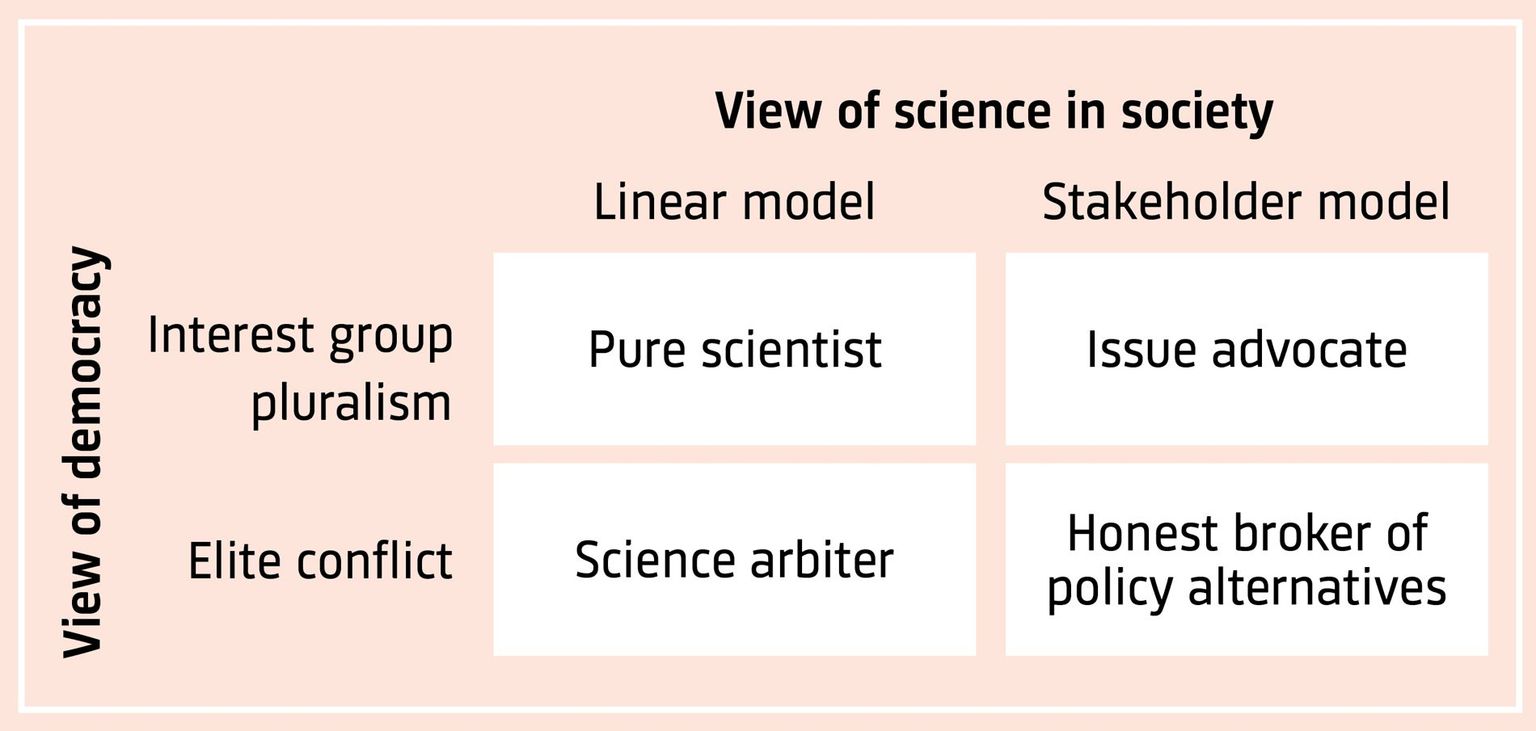
He distinguishes between four ideal-type roles (or ‘modes of engagement’) in which scientists can contribute to policy and political decision-making (figure 3). The four roles position scientists in relation, first, to the main perceived purpose of knowledge production and respective impact (determining how strongly science is related to the expressed or perceived needs of societal actors), and second, to the kind of contribution one chooses to make to decision-making as a scientist: as someone adhering to a specific political conviction (according to ‘interest group pluralism’) or as someone who identifies as an expert (and contributes willingly or not to the elite’s competition of ideas: the ‘elite conflict’). Pielke explicitly argues for taking on the ‘Honest Broker of Policy Alternatives’ position, ideally together with other experts, because this role is the only one in his view that fulfils the requirements of functional democracy and disengaged, pluralistic scientific insight.
Role of scientist | What does the scientist do in this role? |
|---|---|
The pure scientist | In this ideal-type role, a scientist pursues knowledge production without interference with or from the political or practical sphere; he or she has no interest in policy’s shares some fundamental information about factors involved. S(he) does not see herself/himself as part of an interest group. |
The science arbiter | This role supports decision makers (the ‘elite’) by providing answers to questions that can be addressed empirically, i.e. using the tools of science, e.g. expert advisory committees (such as the Covid-19 taskforce in Switzerland). The scientist serves as a resource for the decision-maker, standing ready to answer factual questions that the decision-maker thinks are relevant. The Science Arbiter does not tell the decision-maker what he or she ought to prefer. |
The issue advocate | The defining characteristic of this role is a desire to reduce the scope of available choices brought into the democratic sphere by different stakeholders, often to a single preferred outcome among many possible outcomes. The Issue Advocate thus ventures into telling policy what they ought to prefer by making the case for one alternative over others. |
The honest broker of policy alternatives | The defining characteristic of the honest broker is a desire to clarify, or sometimes to expand, the scope of options available for action. ‘Honest’ implies that what is important in this role is the commitment to clarify the scope of possible action so as to empower the decision-maker. Honest brokering of policy alternatives is often best achieved through a collection of stakeholders working together with a range of views, experiences, and knowledge. |